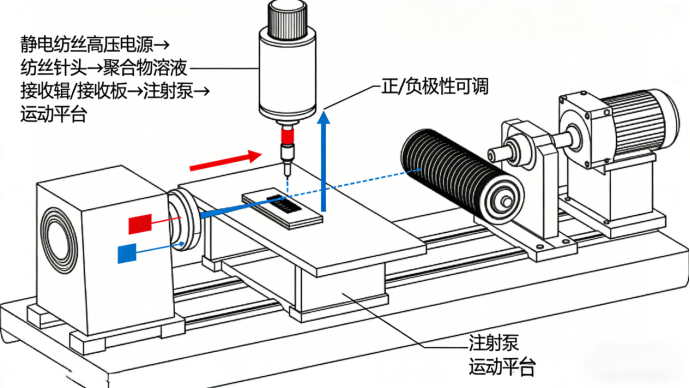
Application Introduction
Electrospinning is essential for fabricating nano-scale ultrafine fibers. Polymer melts or solutions are stretched under high electrostatic fields to form fibers from tens to hundreds of nanometers, widely used in R&D of medical dressings, lithium battery separators, filter media, catalytic materials and functional composites for university material and chemical engineering labs.
Core Power Function
1. Provide adjustable 0~50kV DC high voltage between spinneret and collector to form strong electrostatic fields, creating Taylor cones and stretching polymer into uniform nanofibers;
2. Positive/negative polarity switching and dual synchronous output adapt various polymer materials;
3. High-precision voltage stabilization ensures uniform fiber diameter without beads or breakage.
Differentiated Advantages
Linearly adjustable output voltage, stability ≤±0.2%, low ripple, built-in short-circuit/arc protection and program control support from laboratory trials to pilot production.
Working Principle
High voltage creates strong electrostatic fields to form Taylor cones. Polymer fluid is stretched into nanofibers and deposited as porous membranes for developing medical dressings, battery separators and advanced filter materials.
Application Scenarios
University material & chemical research, nanofiber development, medical dressing preparation, lithium battery separator R&D and catalytic material production.